
A bed is a stack of decisions, and almost everyone makes the expensive ones carefully and the cheap ones by accident. The mattress gets research, showroom visits, a committee. The pillow, the object that actually holds the head and neck for seven to nine hours, gets grabbed off a shelf in the time it takes to squeeze it once. Then the neck complains for a decade and the mattress takes the blame.
The small equipment of good sleep deserves the same attention as the big purchase: what pillow loft actually is and how to match it to the way you sleep, why we fill our pillows with shredded foam behind a zip instead of deciding your loft for you, where a body pillow and a knee wedge fit into a side sleeper's night, and how the bathroom scale, of all things, becomes a genuinely useful sleep instrument the day you stop reading it one morning at a time. The products are the pillow and Fit layers of EnerPlex beds and pillows. The sleep guidance is public and linked at the end with the dates we read it.
Loft, the measurement nobody names
Loft is the height your pillow holds your head above the mattress once your weight settles in, and it is the entire job description. The test of correct loft is alignment: with the pillow doing its work, the neck continues the line of the spine, the way the head sits over the shoulders when you stand with decent posture. Too much loft and the head is propped forward or cranked sideways all night, too little and it sags below the line, and either way, muscles spend the night doing quiet labor they will invoice you for at dawn.
The complication is that correct loft is not a property of the pillow. It is a property of the pillow, the sleeper and the mattress at the same time:
| You | The geometry | The loft that fits |
|---|---|---|
| Side sleeper | The pillow must fill the whole shoulder-to-ear gap | High. This is the tallest order in the table |
| Back sleeper | Only the neck's natural curve needs support | Medium to low, with support at the neck rather than the skull |
| Stomach sleeper | Any height cranks the neck up and sideways | Minimal, or none, and most necks are happier off this position entirely |
| Broad shoulders on a firm surface | The gap grows because the shoulder cannot sink | More than the same person on a soft mattress |
| Any sleeper on a soft mattress | The shoulder sinks, the gap shrinks | Less than the label would guess |
Read that table twice and a problem appears: the pillow on the shelf was manufactured before the maker knew anything in your row. A fixed pillow is a guess about a stranger. That is not a manufacturing flaw. It is a category flaw, and it is the exact reason our pillow line is built the way it is.
The zip changes the argument
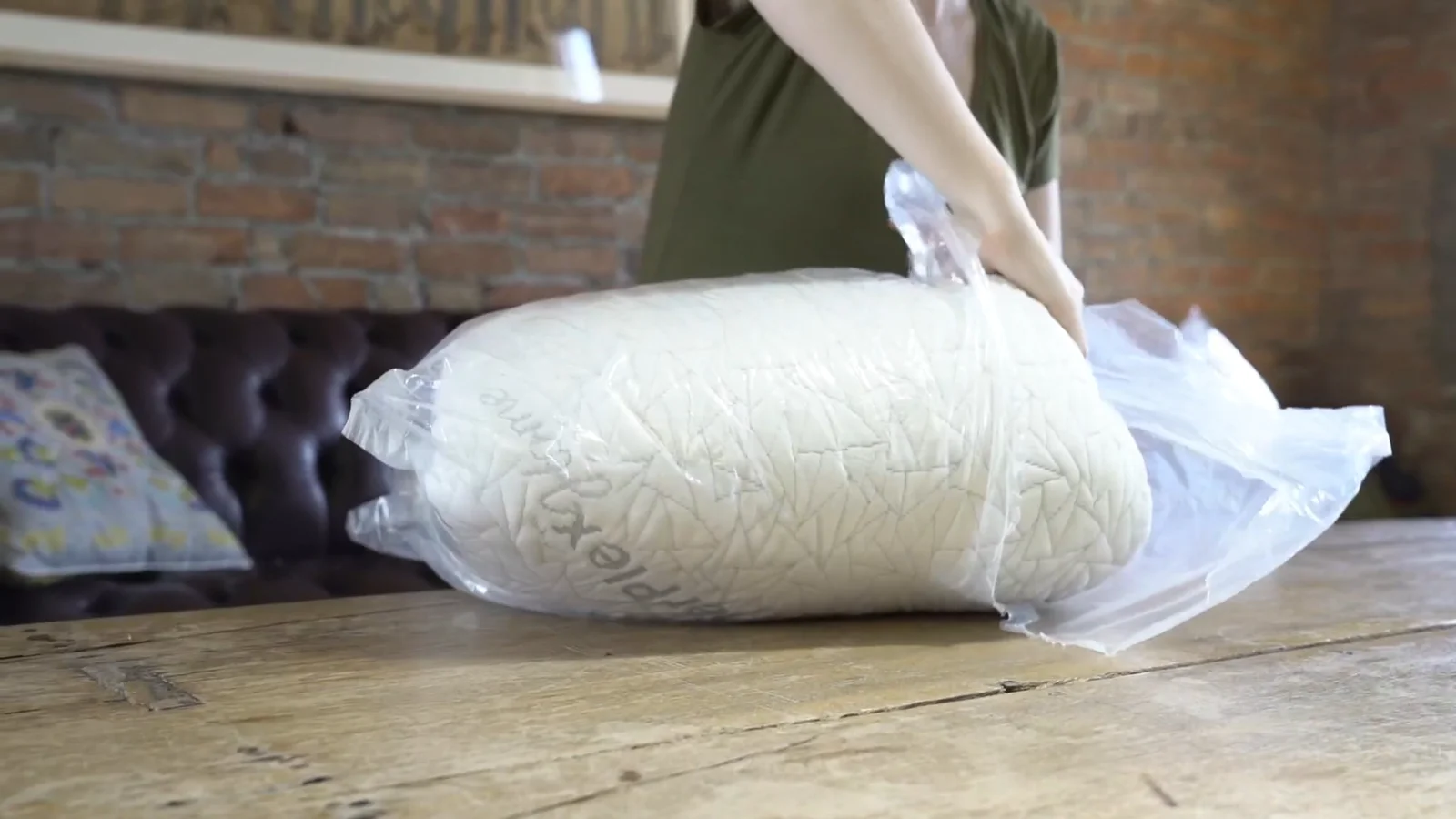
Every pillow we make is filled with shredded memory foam behind a zipper. Open it and the fill moves by the handful: take some out, the loft drops. Put it back, it rises. The removed handfuls wait in a freezer bag on the closet shelf for the day your mattress, your shoulders or your sleeping position changes the arithmetic. Loft stops being a factory decision and becomes a household setting, adjusted in minutes, reversible forever.
Shredded fill carries three other properties a molded slab cannot offer. It breathes, because air moves between the pieces instead of through a monolith, and sleepers who run warm notice the difference. It recovers, because a thousand small pieces re-fluff where one compressed slab holds its dent. And it launders: the whole pillow, fill and all, goes through the machine and comes back itself, which is a sentence no slab pillow can honestly print. The foam itself is CertiPUR-US certified, made without formaldehyde, regulated phthalates, mercury, lead or the flame retardants the program screens against, with a public directory where the certification can be checked by anyone. We say more about what we will and will not claim on the certification shelf of the front page.
Honesty requires the next paragraph too. Shredded fill ships compressed, and a new pillow arrives flatter than its photographs and stays that way until you work air back into the pieces. One of our four-star reviewers documented the experience precisely:
It comes flat out of the package and stays that way
That is real, it is the physics of compressed foam in transit, and the writing on our own pages now says what the review says: plan on a day and a few rounds of honest fluffing before judging the pillow you actually bought. The reviewers who gave it that day tend to sound different:
*update--after 5 months of daily use, the pillows are just as comfortable and cushy as when I first got them.
The body pillow, or geometry for side sleepers
Side sleeping is the most popular position and the most under-equipped. The head pillow solves the shoulder-to-ear gap and then the rest of the body is left to improvise: the upper arm wants a shelf, the upper knee slides forward and drags the hip into a twist, and by 3 a.m. the spine is a question mark.
A body pillow is the blunt, effective answer: fifty-four by twenty inches of the same adjustable shredded fill, running parallel to the sleeper. The top arm hugs it instead of collapsing across the chest. The upper knee rests on it instead of diving for the mattress, which keeps the hips stacked instead of twisted. Pregnant sleepers, who are instructed into side sleeping whether they like it or not, discover all of this at once, and that is when most households buy their first body pillow: in the pregnancy months, and the years after are when everyone else in the house steals it.
Because the fill is adjustable end to end, the same pillow can be tuned firm at knee height and softer at chest height, which no fixed-fill tube can copy. And because it is one washable object rather than an arrangement of three spare pillows, it survives being loved by a household. One of our reviewers, a self-declared best-body-pillow-I-have-owned skeptic, summarized the fixed-fill problem we built against:
It is by far the best body pillow I've ever had. It really "holds it is shape".
The knee wedge, including who should skip it
The knee pillow is the smallest object in our catalog and the one we are most careful talking about. What it does is geometry: a contoured block of certified foam that sits between the knees of a side sleeper, keeping the upper leg from sliding forward and down, which keeps the knees apart, the hips level and the lower back out of the twist it would otherwise hold for hours. Sleepers who arrive at it after weeks of bad nights sometimes report the change in the first one:
I slept through the night without waking once and with no lower back pain -- a first in years.
That is one sleeper's night rather than a promise, and a pillow is comfort equipment rather than treatment. Pain that persists belongs to a clinician, not to a foam wedge, and nothing on this page is medical advice.
The honest fit notes, straight from our three-star reviews, because those are the ones that teach: the wedge has a definite thickness, and a smaller-framed sleeper can find it holds the top leg higher than comfort wants. One reviewer put it in a sentence we keep on file:
I think this is a little too thick for most people, your top leg goes higher than needed.
Some sleepers also simply prefer the full-length solution: a body pillow does the knee separation job and the arm-shelf job at once, at the cost of more real estate in the bed. If you already know you sprawl, start with the body pillow. If the single complaint is knees and hips, the wedge is the surgical tool. Its cover zips off for the wash, the certified foam warms and shapes to the leg within minutes, and it weighs nothing in a suitcase, where it doubles as the best flight pillow a lower back ever had.
The number by the bathroom door
A guide about sleep equipment ends at the scale for one reason: the two conversations use the same wrong unit. People judge sleep by a single bad night and weight by a single bad morning, and both judgments are noise pretending to be news.
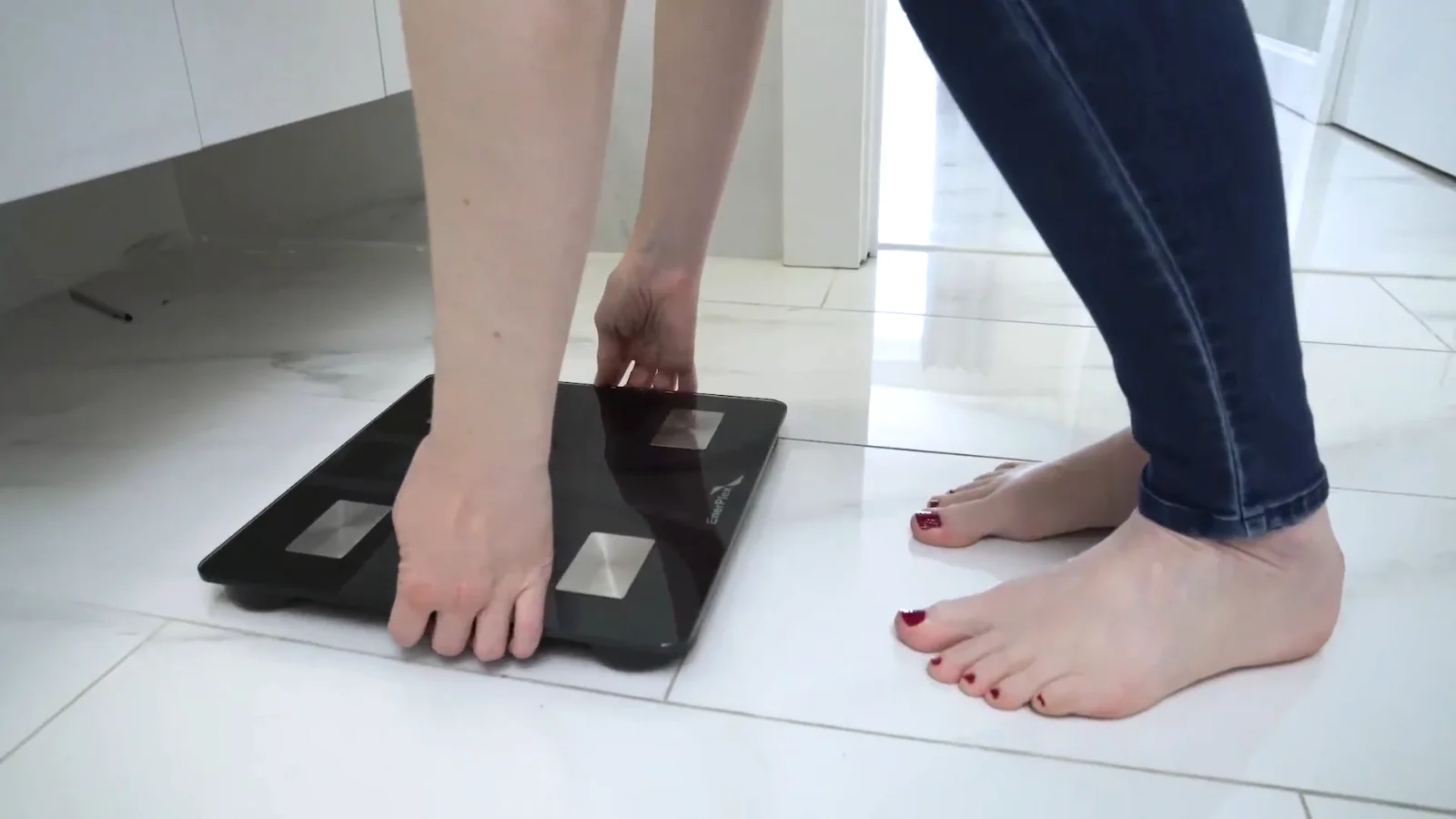
A body is a moving average. Day to day, weight swings by pounds on water, salt, timing and half a dozen other inputs that have nothing to do with the season's actual direction. A single weigh-in cannot see through that. A trend line can. That is the entire philosophy of the Fit layer of our range: two Bluetooth body composition scales, black glass or white, that hand every weigh-in to the phone app automatically, where the mornings stack into the only version of the number that means anything. No transcription, no memory, no motivated forgetting. One long-term reviewer, comparing against the professional-grade equipment she tracks with, wrote:
I have used professional grade BIA scales, like InBody, and a few others (including Nokia Withings).
Her conclusion, in her own title: more accurate than most such devices she has used. We will add the calibration habit that makes any scale trustworthy, ours included: same scale, same patch of hard flat floor, same time of day, ideally first thing. Consistency is what makes Tuesday comparable to Thursday. The tile does the rest. And the reading discipline is the same as the pillow discipline: adjust, give it days, read the trend. A scale read one morning at a time is a mood machine. Read by the week, it is an instrument.
Washing, fluffing, and how a pillow ages
Pillows have lifespans, and most households run them years past the finish line because nobody publishes the maintenance schedule. Here is ours, for the equipment on this page.
Wash the cover monthly and the whole pillow a few times a year. The quilted covers zip off and run with the regular laundry. The pillow itself, fill and all, machine-washes and returns to its shape and size as it dries, which is the single most underrated property of shredded fill. A slab pillow that meets a washing machine usually comes out a different, worse object. Dry thoroughly, low and slow, and finish with the fluffing routine: grab, pull apart, repeat, the same motion as day one. Damp foam in a closed cover is the one mistake the design cannot forgive, the same rule the camp beds live by.
Re-tune at every change of mattress, and expect to. The mattress sits in half the rows of the loft table for a reason: a new, firmer surface raises the shoulder gap and wants a handful of fill back in, and a softer one wants a handful out. The freezer bag on the closet shelf is not clutter, it is the other half of the pillow.
Retire fill honestly. After years of nights, any foam slowly loses its spring, shredded or not. The zip turns retirement from an event into a top-up: refresh the fill, keep the cover, and the pillow you tuned stays the pillow you tuned. When a pillow no longer holds the loft you set the evening before, that is the whole diagnostic.
When the bed itself should do the pillow's job
One pillow problem cannot be solved by any pillow, and honesty says so: on a smooth-topped airbed, the pillow itself migrates. Vinyl offers a pillowcase very little to hold, and an active sleeper can shuffle the best-tuned pillow in the house straight onto the floor by 3 a.m., after which no amount of loft theory matters.
We solved that one at the architecture level instead. The pillow-rest models in our airbed line raise the head end of the air chamber itself, a built-in incline that gives the pillow a pocket to sit in and the sleeper a defined head of the bed. The pillow stays, the loft you tuned stays under the actual head it was tuned for, and the bed reads one notch closer to furniture, which is the whole trajectory of our home line. If your nights happen on an airbed more than a few times a season, that feature is worth more than a second pillow, and the full size-by-size walkthrough lives in the guest-bed guide.
The general principle deserves its own sentence, because it is the quiet thesis of this whole page: fix sleep problems at the lowest layer that can hold the fix. A sliding pillow is a chamber-shape problem before it is a pillow problem. A cold camp night is a ground-layer problem before it is a sleeping-bag problem. A stiff morning is an alignment problem before it is a mattress-shopping problem. Work up the stack, cheapest layer first, and most nights get fixed for the price of a handful of foam moved in the right direction.
The seven-night experiment
All of it compresses into one protocol, run over a single week, at the cost of a few minutes a day.
- Night one: diagnose. Lie down as you actually sleep and have someone photograph your neck, or video yourself. If the head kinks up, remove a handful of fill. If it sags, add one. Side sleepers, note what the top knee is doing at lights-out.
- Nights two and three: tune. One handful at a time, one change per night. The freezer bag of spare fill lives on the closet shelf. Side sleepers add the body pillow or the wedge and let the hips report back.
- Every morning: step on the scale before coffee, then ignore the number. The app is keeping it. You are not deciding anything on day three.
- Night seven: read the week. Neck report, hip report, and a seven-point trend line that actually means something. Keep what worked. The zip makes every decision reversible.
The public sleep guidance says adults need seven to nine hours in a dark, quiet, comfortable room on a consistent schedule. The pillow, the wedge and the scale are the comfortable part of that sentence, tuned to the only body whose measurements matter, which is yours. The pillows, the wedge and both scales live on the front page with prices from our latest refresh, on the schedule described in How we update this catalog. And if the bed under the pillow is the actual problem, start one guide over: the two-minute answer is in The Guest Room That Lives in a Closet, and the outdoor version is in Sleeping Warm Off the Ground. The last inch of the bed is the cheapest one to fix, and it is the inch your neck lives on.
